Näytetään tekstit, joissa on tunniste Interviews in English. Näytä kaikki tekstit

torstai 19. lokakuuta 2017

ARTTU ARTKOSKI & CARINA QUIROGA: Buenos Aires / DNI / Tampere


This story begins with a girl in the rural city of Tostado in the province of Santa Fe, Argentina, and a boy in the rural city of Lahti, Finland. Unaware of each other, they both start dancing Argentine tango, and eventually both find their way to the DNI tango school in Buenos Aires. A shared future starts to take shape, and eventually the two, as a family, find themselves as tango teachers in Tampere, a Finnish city with an unusually vibrant tango community.

 
Arttu, Nina and Carina at home. 


 On a sunny early September´s day of 2017, my partner and I were cordially received in their cosy townhouse, in a park region not far from central Tampere, and I had the opportunity to make this interview.


CARINA

In Carina´s childhood, Tostado was a small, quiet village. There was no concrete yet on the street in front of her house, so after a rain it was very muddy, and Carina and her playmates loved to slide in the mud. Her family´s backyard was a very popular place to play for all the neighbour´s children, including herself and her three siblings. As a child she was very active, playing football and climbing in the trees; but of course she also played with dolls.

Part of the backyard was elevated, and functioned as a ´stage´ for their ´Folklore orchestra´, with Carina on bombo [a drum], and the brothers on guitars. Already at a young age, Carina showed talents in arranging events. First at the age of 9-10,  by arranging twice a Friend´s day (20th July) party for her friends, with self-made invitation cards and pastries, and a dress code defined by mama´s old clothes and with make-up! Later, at the end of secondary school, she would twice raise money for a final school trip to Bariloche in Patagonia, by organizing dance parties for teenagers, 15-16 years of age. While still at school, Carina even acted as news reader in the local radio, also making cultural programs, with topics such as nature and fashion.

 
Carina (at right) with her brother Gabriel and his fiancé Soledad.


Carina´s father had a folklore group playing the guitar and singing, and she herself was dancing and performing folklore at the age of 7 to 12. At that time, there was a popular TV program by the name Grandes Valores del Tango, with dance performances, which the family used to watch together. Carina liked to watch the dancers dancing, but did not yet have the opportunity to do tango herself — except for a single class with her brother. At the age of 17, she moved to Paraná to study at the Journalist line at the university, more specifically on graphic design. Later she would establish an enterprise of her own, and work with graphic design for ten years.

Accidentally, the students at the University were offered free lessons in Argentine tango, and Carina enrolled — and was soon taking classes 4 times a week, eventually for a period of 5 years.  There were two teachers, she recalls: "one was an old milonguero and the other was one of his students, a very enthusiastic history teacher ". Eventually, for a period of two years, Carina hosted a weekly milonga in Paraná, together with a dancer from Paraná, Pablo Villaraza, who was later to co-found the dance school DNI in Buenos Aires. For some 4 years, Carina also practiced contemporary dance, dance-theatre and some ballet in Paraná.

 
Carina performing at a Paraná milonga.


Already when living in Paraná, Carina started to take classes in Buenos Aires, by visiting the city for a weekend once each month, and "taking all the classes she could". In 2006 she joined classes at DNI, and in 2007 she even organized the first ever DNI Tango Company Show at the Paraná theatre, doing the production!  "Only at DNI", she recalls, "I was instructed about body mechanisms. Earlier nobody had said anything on that matter".


Carina (in the back row) with her DNI group, in 2008.

In 2008 Carina moved to Buenos Aires, and started to give prácticas at DNI. Seven months later, a man from Finland, by the name of Arttu, appeared at her práctica...


ARTTU

Arttu grew up in the peaceful Mukkula area, a bit outside the urban parts of Lahti. "I was blond and shy", he says. "I was really kiltti [Finnish word for tame & gentle]". He was a profuse reader, and good at school. He used to go directly from school to the City library, and while he preferred nonfiction books of facts, the hero of young boys of the time, Tarzan was of course also on the menu — and is still to be found in Arttu´s bookshelf.


Arttu with books from his childhood.


When Arttu was eleven, the family moved to Tampere.  He practiced slalom and bicycling, and used to make the 32 kilometer trip to their summer cottage on bicycle, back and forth!  Even though, he did not consider himself to be a sportsman. At school he rather liked writing and drawing, and he was frequently contributing to the School magazine. When the school tutor presented him with different options for further studies, the Technical High School seemed an interesting choice. That path took him first to Architecture studies, which led him to travel to Japan. Later he got involved in computer applications and programming, which then became his career.

In 1986, Arttu started practicing Aikido. He pursued Aikido for over 20 years, in his most active years 2-3 hours a day, including giving classes. In addition to Aikido, he practiced other soft martial arts like Iaido, Kyudo and Taichi. Today he considers these 20 years to have been very useful preparatory step for Argentine tango. "Practicing Aikido", he says, "I learned to feel and lead the partner. The basic difference is that in Aikido you try make the partner fall, and in dance you try to keep her not falling". And in Taichi you learn the flow of energy, he explains.

Dancing — and Argentine tango in particular — came into Arttu´s life "by accident". In 2006 a friend at his workplace, who attended the dance school Tanssis, pursued Arttu to join in. The curriculum consisted of Finnish social dances, but incidentally a tango teacher, Miguel Angel Pla from Buenos Aires, was giving a weekend tango seminar.  Arttu was fascinated, and decided to continue. The same summer he also enrolled for Dance Pedagogy studies at the Open University in Jyväskylä.  The 1-year curriculum included Ballet, Contemporary dance, Folklore, Dance Therapy, and more. In Tampere, Arttu started to study and teach at the Tanssis dance school, and in 2010 he would eventually earn the Finnish Dance Teachers´ Association´s membership.


THE ENCOUNTER

Let´s go back to the year 2006, when Arttu joined a group from the Tanssis dance school for a trip to Buenos Aires — again "by accident", because another person had cancelled his registration! "It was a nice experience", he recalls. He especially remembers the New Year´s party at a fountain near the Obelisco, and dancing in Gricel with a porteña [local, i.e. not tourist] milonguera, who told him: "You dance too fast!". Arttu´s next trip to Buenos Aires was in October of 2008 until January 2009. He started to take group and private classes at DNI, and had private practicas also with Carina.  Arttu spoke no Spanish and Carina no English, so they did not communicate too much. Arttu also attended the classes of Oscar Casas at El Beso.


A  recent couple in 2010


When Arttu in February 2010 returned for a 2-month visit, Carina had started to talk English, and they could now communicate.  On one occasion, when Carina had two tickets to a jazz concert , Arttu offered to accompany  her, and — as they both say with a laugh — the rest is history!  Carina started to visit Tampere a few months at a time, and they began to give tango classes both in Tampere and in other locations. In 2013 they finally moved to live permanently in Tampere, and have become an important resource for the tango community both in Tampere and nationally.


A framed  flyer from their first joint teaching.
  

Carina and Arttu are still making yearly 3-month trips to Buenos Aires. Carina works two months at DNI, and both of them enjoying classes by top artists, such as Mariano ´Chicho´ Frumboli & Juana SepulvedaJoe Corbata & Lucila Conci, Gastón Torelli & Mariana Dragone and of course with Dana Frígoli & Adrián Ferreyra.


TEACHING TANGO

My partner and I had the pleasure of  participating in one of the earliest classes that Arttu and Carina gave in Finland; a milonga-course in Huittinen, in 2011. Later, we have enjoyed their teaching at tango camps, festivals, and in individual seminars. From the very beginning, we have perceived them a very warm-hearted teachers.

 
Arttu and Carina in Huittinen, 2011.


So, I asked them: "What kind of teachers would you describe yourselves to be?" There was a brief pause, they looked at each other, and with a laughter they replied: "funny", "joking". In a more serious tone, they clarified that — first of all — they wanted the students to feel relaxed. "And if we can make them laugh, they will feel more at ease", I was explained. "We think that it is easier to learn in a gentle and warm atmosphere". Arttu and Carina strive to ´humanize´ both the students and the teachers: "We are not afraid of making mistakes. If we make a mistake, we say: do not do like this!"

Carina tells that she likes to work with the idea of "teaching by touching". She uses physical guiding of the student´s body, rather than verbal explanations, because she thinks that some sensations can be remembered by the body forever. Arttu works by defining the chains of connection "from the embrace to the tip of the toe", and uses "lots of words".  In private classes, they both work a lot with bodily details, to make the student understand the mechanisms of the movements. During the last few years, they have required that the students dance  in a close embrace from the very beginning. "This has made learning so much easier", they conclude.


                                                                          Arttu and Carina´s tango home page.


Arttu and Carina prefer to teach groups of limited size (maximally about 15 couples), to ensure individual attention. For each class, they like to have a clearly defined topic, for example ´walking and abrazo´, or they may look into different aspects of a recent topic. One of the challenges for a tango teacher is to help the student to progress beyond the keskitaso (medium level), because many years of dancing will not, by itself, make you truly edistynyt (advanced level). However, "as a teacher you can only give the student a direction".  The student has to develop his/her own dance. "We can give a lot of material and help with the physical side, but you have to explore and develop your dance, yourself!"

An exciting new aspect in their teaching is the inauguration of a new dance studio, which they are opening in collaboration with their friends and colleagues Pasi and Maria Laurén. It is situated in central Tampere, in a renovated factory, and will open during this autumn.


TANGO OUTFITS & GRAPHIC DESIGN

When you go upstairs to the second level of their home, you enter Carina´s creativity territory. In the hallway is a folding table for patterning and cutting fabrics, and in an adjacent room is her atelier. There is Carina´s desk, with a sewing machine and a computer, side by side. Although a professional graphic designer, in Finland she has not been doing any graphic projects — except for providing, as a voluntary hobby, the Tampere tango community Tango aMoroso with their advertising materials.

When our discussion turns to dressmaking, Carina hastens to humbly remark that she is "not a professional", and that sewing is "just her hobby". However, a closer interview reveals— at least in the mind of the interviewer — a level of experience no less than a "professional amateurship", the roots of which date back two generations. In her childhood Carina was taught both by her grandmother and her mother, who were used to provide their families with practically all the clothing needed. Carina sew and knit clothing for her dolls, and as a teenager she started to make outfits for herself. Even though much of a teenager´s garment had to be obtained otherwise, Carina "always made something for herself". When living  in Paraná as student at the university, she did not have extra money to pay a dressmaker, so she started to make her own dresses for tango. Later she made dance performance garments for the local dance company. In Buenos Aires she was manager of the DNI Tango Store, and there she developed and designed products like clothes and shoes.

 
Carina showing clothes from her collection.


In 2013, soon after Arttu and Carina had settled in Tampere, their daughter Nina was born. Staying the first two years at home with the baby, Carina restarted her sewing hobby as a pastime activity, making clothes for Nina and for herself. "Ladies started to ask where my dresses were from, and  asked me to make garments for them — and I made a few", she recollects. Little by little that grew to a collection, which she showcases on selected tango events. "I do not take private orders, with individual measures", she specifies. "I make my dresses in three sizes, the precise measures of which may vary a little". She  stresses that a good fabric is essential, and acquires material from specific sources both in Finland and in Argentina. For herself to wear, she prefers non-shiny (´matta´) materials, in rather dark colours — green, black, blue, gray — and a concise (´pelkistetty´) design, but her collection is wider, as many dancers are inclined to more challenging looks.  Carina is also providing dance shoes from DNI. She stresses that neither her garments nor shoes are available through internet, only on her expositions at tango events.


 Junto ayer (2010),  junto hoy y en adelante!


torstai 31. elokuuta 2017

ALEJANDRO JAIME — Argentinian Tango Teacher, Dancer and Musician


Ever since September 2016, when Alejandro Jaime started to visit Turku, my partner and I have enjoyed both his teaching and the chance to spend some spare time in his company, both in Turku town and in the archipelago. Alejandro is never boring, and a conversation with him may include both playful elements and deep philosophical pondering.


Alejandro during the interview at his tango studio.


To the tango community of Turku, which lacks a local professional teacher of Argentinian tango , Alejandro is a much needed resource. I am happy to be able to present this profile of him, to entertain present and coming students of his, and others. 


A CULTURAL CHILDHOOD

Alejandro grew up in the Buenos Aires neighborhood (barrio) of San Christobal, known for its artistic community. The European roots of his mother were in the Russian-Polish population, known for its cultural richness, and Alejandro describes their family as not having been wealthy, but very educated.  Family pursuits included reading literature, and listening to and playing music. Very early, Alejandro´s mother started to teach little Alejandro letters and words from signs, labels, and advertisements in the streets. As a result, Alejandro was reading at the age of three — and later "felt very bored at school". Also at the age of three, a prediction was made. Little Alejandro was sitting on the floor when his mother was doing vocalizing exercises, while her teacher accompanied on piano. Observing the boy´s reactions to the music, the teacher predicted: "he will be a musician".


Family photo at age of 12.

The cultural ambience of Alejandro´s childhood was not restricted to his family. In the apartment building where they lived, the neighbors included painters, writers and musicians, and people interacted lively. At home, as well as in the whole building, Latinoamerican music, folklore, rock and tango sounded. The mother, a language teacher, was an amateur singer of latinoamerican music, and studied in the conservatoire. Alejandros father was an excellent amateur singer of tangos. The father died when Alejandro was very young, but Alejandro tells that he "can still hear his voice singing". When the mother entered her second marriage, Alejandro got the stepfather Edward, who played the guitar. Luckily, Alejandro and Edward developed a very friendly relationship, which has persisted into Alejandro´s adulthood.

The kindergarten that Alejandro went to at 1-3 yrs of age, was situated on the other side of the street, opposite to his home. As a prophesy for Alejandros adult life, this habitat was later turned into a milonga place — the Cachirulo! A place where he would later be dancing and performing...


Class photo at the Arts School. Alejandro 3rd from left in front.

Between ages of 6 to 11, Alejandro attended an Arts school for kids in the morning, and the normal school in the evenings. The curriculum of the Arts school included Music (singing, playing instruments), Theater, Visual arts (painting and sculpture), and Body awareness/dancing. "I loved theater", he recollects. I ask him what he remembers from the dance lessons of folklore and tango. "I remember the embraces, but nothing else", he tells with a laugh.


MUSICIAN

"As a youngster, I used to listen to, and sing folklore, pop music, and kids´ music", Alejandro recollects. At the age of 10, he played the keyboard. But his instrument was to be the guitar. In his family, this instrument was played a lot, and there were weekly intellectual gatherings with a lot of eating and singing, with guitar accompaniment. He remembers that "something turned on in my ears", and at the age of 16, he was hobby-playing the guitar. But the decisive moment came at the age of 18. A brother of one of his friends was said to be very good at the guitar, and Alejandro got the opportunity to listen to him. He was playing the Allemande from Bach´s Suite N:o 1 and Las Abejas by the Paraguayan guitar composer Agustin Barrios.  "I was amazed", says Alejandro, "and I instantly decided, that I wanted to play that music". The next 12 years he would be rehearsing 6-8 hours a day...!


Diligent guitar rehearsing for the International
contemporary music and composition Festival in Cordoba 2010.

Initially, Alejandro was practicing by himself. One day, when he was walking in the city with  a guitar friend, and they passed the the Conservatory Manuel de Falla, they heard guitar music from inside. They went to see, and in the corridor someone was playing the guitar. Alejandro and his friend joined in on their guitars, and soon the other person approached and suggested that he would introduce them to his guitar teacher. "The stubborn old man" — Alejandro remembers — "told me that I should apply to the Conservatory". 

Alejandro decided to apply, but a few days later he learned that the application date had passed two weeks earlier!  He now started to practice even more than before. He moved to the friend´s place, literally a woods workshop with no regular facilities, one hour´s travel from the center of Buenos Aires. "We were three men, connected by a passion for music and literature". The days were filled with intensive training and lively discussions.

                                              Alejandro testing a Luthier instrument playing the 
                                             Allemande BWV 996 by Johann Sebastian Bach. 
                                           

Next year,  there were six hundred applicants for the 25 vacancies at the Conservatory Manuel de Falla, which is the most important guitar playing conservatory in Argentina.  Alejandro not only succeeded to get enrolled — he got the highest position! He spent 8 years in the conservatory, also studying composing and Early music. From the very day of his admittance, when he was taken to perform in a venue, he steadily gave performances, and was also giving private lessons.  Until ultimately a period would arrive, when tango dancing defeated guitar playing...


DANCER

Earlier, Alejandro had been dancing popular dances, such as folklore, bachata and salsa. At the corner of the Conservatory, there was a salsa studio where he used to go three times a week to dance salsa!  Some of his friends at the Conservatory attended the Department of Popular music, which included tango music, and they invited him to try tango dancing.  Alejandro immediately felt that "his body remembered" something from his childhood lessons at the Art School. He liked the feeling, and he promised himself "I will do this in the future!" Not yet, because he had recently got a scholarship from the National Arts Foundation, for postgraduate guitar studies.

The definitive decision to be a tango dancer was made some time later  — as a result of jealousy!  He was dating a girl who went to milongas (alone). "I was very jealous", Alejando remembers, so when she invited him to join her for a milonga, he accepted. At this local milonga, he immediately felt comfortable and easy. However, when he went to more advanced milongas, he started to "feel terrible", because he understood that he was not yet dancing at a good enough level. As a result, he started to join his girlfriend to classes given by Helen "La Vikinga" and some colleagues of her.  This training lasted only one month, because the girlfriend moved to the USA, but it had one important consequence: Alejandro learned to know Javier Rodriguez, who was a friend of La Vikinga. This would have later consequences, but at the moment Alejandro considered Javier to be just a ´friend of a friend´.


Small group at Alejandro´s studio in Buenos Aires 2015.

Alejandro decided to get to the very bottom of tango dancing. "I need to go to traditional teachers", he thought. As a recommendation from a classmate in the Conservatory, he found the tango classes in Palermo given by Jose Almar and Juliana Aparicio, who were teaching small groups only. However, he was soon disturbed by the fact that teachers quite suddenly went on tours, disrupting the coherence of the teaching. The solution: Alejandro rented a place with a big studio, equipped with mirrors. He started to analyze, very carefully,  videos of dancers with different styles, including Ramon "Finito" Rivera, Puppy Castello, and Javier Rodriguez.  Alejandro especially liked the dancing of Rodrigues. Why? "He is emotional, serious, sensitive, and deeply connected to the music and to the dancing", Alejandro explains.

Alejandro started to go to milongas in a very methodical way: initially to not-so-good places, to be able to dance as many tandas as possible, and gradually to better and better places, where he could dance with more demanding partners. One day — a week  before his birthday — Hector Cachirulo, who was the organizer of the milonga Cachirulo, surprised him by saying "pick a partner and perform next week". The partner he picked was a girl from Brazil, named Arlety, and their performance was a success.


First public performance, at Cachirulo.

As Javier Rodriguez was mostly touring abroad, he was not an option to get classes from. Instead, Andrés Laza Moreno — a former assistant to Carlos Gavito — became Alejandro´s tutor, "to whom I owe almost everything", he says. Alejandro started practicing with many partners, gave public performances, and also won a competition night in Buenos Aires. 

Maximilian Christiani invited Alejandro to join his dance company; and so Christiani became Alejandro´s trainer for a period of time.  Some of the professional dancers in the milongas, knowing that Alejandro also was a musician, asked him to give private lessons. In 2015 he gave several workshops, and in 2016 special 4-workshops packages. In those workshops an organizer from Italy, and another from Belgium participated, and they invited Alejandro to come and work with them. In Europe the invitations multiplied, and soon Alejandro decided to stay in Europe. His partner had settled in Barcelona, and this became their home town for 6 months, until they decided to move to Helsinki.


TEACHER

Alejandro tells that he has always loved teaching, be it guitar playing, martial arts (see below) or tango!  As a dancer with a deep knowledge in music, his special topic  is Tango musicality for dancers, but he is also teaching issues related to Body awareness — a topic already familiar from the Arts school — and Dance kinetics. In tango communities, he gives seminars and leads prácticas to larger groups, but at his new Helsinki studio, he prefers to teach groups of limited size. For that, he has developed the Tango LAB concept.

The tango LAB concept.


Although now based in Helsinki, Alejandro will continue traveling on the European continent, both for teaching and for DJing. In the near future he will tour to Berlin, Minsk, and four Russian cities. Alejandro stresses the importance, for students of tango, of having an experienced, first-rate teacher as one´s personal tutor. But he warns that "do not make the mistake of trying to copy your master" — meaning that your tango has to grow from your own premises. He also stresses the importance of continuous, systematic exercises as a prerequisite for any improvements; and with his own daily training hours, he is himself a living example of this principle.


Alejandro rehearsing in his studio.


How to teach?

When I ask Alejandro how he would advice any new teacher-to-be person on what to teach, he present a list that is genuinely Argentinian — quite far the from European/Finnish thinking of  ´give them many figures´. His advises are:
(1) Remember that you are teaching a culture!
(2) Let the students make contact with their feelings .
(3) Give them the music — the music is the essence of tango! Learn them to dance within the music.
(4) Learn them the pillars of tango: good behavior, respect for the music, a good embrace. Remember that the embrace is a concept, not just a posture!
 (5) Teach them a good walk, a good side step — teach them how to step, how to land.
(6) Teach them the 6-8 figures they will need in a milonga: ochos, half turns, small movements. These 6-8 steps will transform into 30 steps, when you vary their rhythm, energy and intensity!                     
(7) Teach how to  play  elegantly with the free leg.
(8) Learn them milonga etiquette: how to invite, where and how to sit, how to dance in a ronda.


       In Alejandro´s classes you are not always upright!
                 Picture from exercise in Rome.


For a good dancer "less is more"! A good dancer is disciplined, focused and sensitive; observes the melody, the rhythm, the intensity and energy of the music — and a real master also knows the story in and behind every tango that is played. "Each tango is a little piece of life".  An experienced dancer also learns to choose. He/she does not dance every tanda, but selects the right partner for the right music, at the right moment!


... AND OTHER ACTIVITIES!

During his active guitar period, Alejandro was also composing. A  collection of those compositions have been compiled into a cute little volume.


Guitar compositions.


Alejandro is frequently DJing, and he has an enormous catalog of tango music: almost 40 GB! Still, this is only 10 per cent of his whole catalog; the remaining 90 per cent is classical music. He is making thorough analysis of both classical works and tangos, and shows me a recent, huge analysis table of Di Sarli´s music, one of the 10 tango orchestras his has recently scrutinized.

DJ at work.


Before he was studying and practicing music, Alejandro also took interest in Martial arts, specifically Taek Wondo. When he was 16, he won the Pan American Championship. The next five years, he earned his living by teaching Taek Wondo.

Demonstrating Taek Wondo


Literature has always been present in Alejandro´s life, and he still is a keen reader. With a background of 2 years of studies in philosophy and psychology at the University of Buenos Aires, books from these genre are well represented in his bookshelf but also other topics, such as anthropology and economics, especially the history of economics (Adam Smith etc.), and he also has a long interest in neurosciences. Russian textbooks plus dictionaries of the Russian language reveal that this language is now under study.

Books at Alejandro´s bedside table

Who knows what new activities Alejandro will embark upon, in coming years!

REFERENCE
Alejando´s website address is http://alejandrojaimeweb.wixsite.com/misitio

maanantai 2. toukokuuta 2016

GETTING ACQUAINTED WITH − Amanda Gris and Maximiliano Carroz


One year ago, my partner and I participated in a tango seminar in our hometown Turku, given by the young maestros Amanda and Maxi from Buenos Aires. We very much liked their inspiring and precise way of teaching, and when informed of their comeback in the spring of 2016, we were in the front row to enroll for both their seminar and for a private lesson.

The maestros outside my place.

Not only were their classes − again − a pure joy to attend, but we also had the fortune to become even better acquainted with this charming couple, as they kindly accepted an invitation to pay a visit at my home.  Our two-hour long chat not only strengthened our perception of their sympathetic characters, but revealed many delightful details from both their professional and personal lives − to be disclosed for the readers of this blog!
ON THE RANCH
Amanda was born in Buenos Aires and grew up in the Villa Crespo district, but she developed a strong link to the countryside since her childhood. Her grandfather owned the ranch Los Corrales Felicia Santa Fé, situated 500 km from Buenos Aires, and there Amanda and her two female cousins would spend their summer vacations and other holidays, as well as a number of weekends.

A view from Los Corrales Felicia Santa Fé [Photo: Eeva-Mari Salminen]

 Amanda adored her grandfather, who "treated us like princesses".  One activity of the ranch was to train horses for races. The cousins learned horse-riding, and their grandfather would join them on long horse rides. In the local community, the grandfather was very respected, because of his honest personality and correct manners. "Those are attributes that I have learned to value highly", Amanda concludes.  Sadly, the grandfather passed away 5 years ago, but Amanda´s father now runs the farm − alongside his occupation as a lawyer.

A view from Quintas San Marcos Sierras

Maxi was born in the capital of Córdoba. At the age of 5 he moved with his family to the community of San Marcos Sierras, which situates 120 kilometers from the city of Córdoba, and is "too small to be found on the map".  Like elsewhere in Argentina, in the 1600´s  the Spaniards took over the territory [at that time named Tay Pichin], and started to grow olives.  Unlike elsewhere in Argentina, in the 1800´s the territory was returned to the original inhabitants, who continued the cultivation of olives. Today, in his Quintas, Maxi´s father is the producer of a refined brand of olive oil.


Aceite de Oliva Don Sergio.

TANGO − AMANDA

"My family on my mother´s side were tango people", Amanda tells me. There were milongueros and bandeonistas, and she remembers that her grandmother used to talk about tango.  Although Amanda was fond of Rock´n´Roll, that was rather for listening only. "My dance was always tango", she recalls. At the age of 14, she decided to go to tango lessons, and for 2 years she attended a local class in Villa Crespo. She recalls having been more interested in the music than in the dance, which for her was "just a game" − until she found Rodolfo Dienzel´s studio.

Dienzel´s book of tango moves.

"I was 19 years old, when I started in ´Cacho´ Dienzel´s classes, and I stayed for 9 years", she tells me. "He was a magician, who gave you a lot of confidence". Amanda recalls never having felt doing anything wrong ["There are no mistakes, only new possibilities"]. Dienzel promoted an active role for the woman ["The woman has the power"]. Early on, Amanda ["La Nena"] was assisting Dienzel in the tango classes.
Amanda describes her deep devotion for ´Cacho´ by saying "he was like my second father". The death of Rodolfo Dienzel in January 2015 not only was a hard blow, but also included a strange event. "I was abroad, and dreamed that my father had died. When I wake up, my cellular phone was loaded with messages of the death of ´Cacho´.

TANGO − MAXI
Maxi´s road to tango was more variable − and flavored with serendipity. Having Indian roots, it is no surprise that Maxi´s dance career started with Folklore, at the age of 6. To put it in the words of Amanda: "Maxi has Folklore in his blood". He attended the local dance school Ballet Folklorico Tay Pichin, and in addition to Folklore also trained in Ballet, Yoga, Tai Chi, and Aerobics. The curriculum also included a kind of choreographed Tango − of which he does not recall much.
At the age of 24, he had been working 5 years in his home community. One day, as he was playing on his guitar and his drums, he started to contemplate seriously on his future. "I decided, that my way is dance" − and he made the decision to move to Buenos Aires, to "learn real tango".
Friends in Buenos Aires had told him to contact them, if he ever came to that town, so he was confident to find somewhere to go. However, as he recalls "I arrived in Buenos Aires at 9 a.m., and started calling friends, but not until 4 p.m. did I get contact with a friend who promised to lodge me for the first 2 weeks". He managed to get an appointment to teach Folklore in Caminito, in San Telmo. "I was living in Belgrano, and working in San Telmo", he recalls with a grimace.

Maxi in an DNI ad.

Maxi began to explore tango under the guidance of Jesus Velazquez, Anita Postigo, Pablo Villarraza, and Pancho Martinez Pey, among others. One day, when he was about to return to San Marcos Sierras for the summer season, he by chance met Stella Dettoni  in the Corrientes street, where the DNI-tango school resided at that time. This encounter led to a 5 year long stay with the DNI, where Maxi not only studied tango, but also gave yoga lessons, worked in the bar, took care of the plants, and later (from 2008) also gave tango classes. "My first performance was with Carina Quiroga, who now resides in Tampere in Finland", he recalls.

In 2011 his friend Jorge Muscia urged him to broaden his tango horizons, saying that Maxi "lived in a single bubble", and naming teachers like Carlos Perez, and Roberto Dienzel. Maxi choose to go to the Dienzel studio. He summarizes the differences between the DNI-tango style and Dienzel´s method as one between "circular" and "linear" dancing. The former style also used more flexion and couple separation than the latter.

TANGO - IN COUPLE
Amanda points out that "Dienzel was famous for coupling dancers into pairs". As examples she mentions Milena Plebs & Miguel Angel Zotto, and Jorge Firpo & Aurora Lubitz − adding that "we were Dienzel´s last match!"

The Poznan Tango Festival 2016 [part of add]

In 2013 Amanda and Maxi started to dance in couple. "It was a disaster", Amanda recalls, since their dancing styles still differed a lot. Maxi agrees with this memory, laughing. To sort out the differences, they started to take lessons from Carlos Perez, whose style they describe as representing "the middle of the road". For both Amanda and Maxi, Carlos Perez has become an authority in whose opinions they trust completely. They are proud that they will soon teach at the same tango festival as Carlos Perez & Rosa Forte.

TEACHING TANGO
In 2013 Amanda and Maxi held their first tango seminar, in Archangel, Russia. They recall that they were "fighting all the trip" about how to teach. Happily, the seminar was a great success. Until the present day, they point out, their curriculum has been constantly developing, and "it is not finished yet".

Maxi giving detailed instructions in Turku.

 When I ask them what "tools" they use in their teaching, they list three main ingredients: (1) Lots of attention to details − much from the DNI experience, (2) Connection and improvisation − much from the Dienzel experience, and (3) Posture and musicality − from Carlos Perez´s teaching. In tango dancing they emphasize flexibility, and "to improvise all the time". They add, with that a smile, that they teach a bit differently in various countries, e.g. taking in account the level of introversion/extroversion of the students. And in classes with students at different levels of experience they try to "add something extra to the more advanced students".

Amanda and Maxi in the Turku seminar.  

GUITAR, OPERA, LAW & PRISON
With his Indian roots and Folklore background, it is no surprise that Maxi plays the guitar. And the fact that Amanda has Italian (and Swiss) roots seems to explain why, at the age of 16, she started to study opera singing − and emerged as a soprano lirica coloratura
Rather more unexpected is the fact that Amanda has graduated as a Criminal Lawyer, i.e. a lawyer who specializes in criminal law. When she studied law, she was already dancing tango. "I was at the university in the mornings, in the prison in the afternoons, and rehearsed tango in the evenings", she remembers.

PHOTOGRAPY, VIDEOS
During the interview, Amanda and Maxi open internet links with beautiful pictures, taken by Amanda. She ascertains that photography is her hobby, but so is also the making of videos ["I always wanted to become a film maker"], and we watch an amusing video compilation from Amanda´s and Maxi´s first professional trip abroad.


                                                Video from trip to Russia.


EN LA GATERA
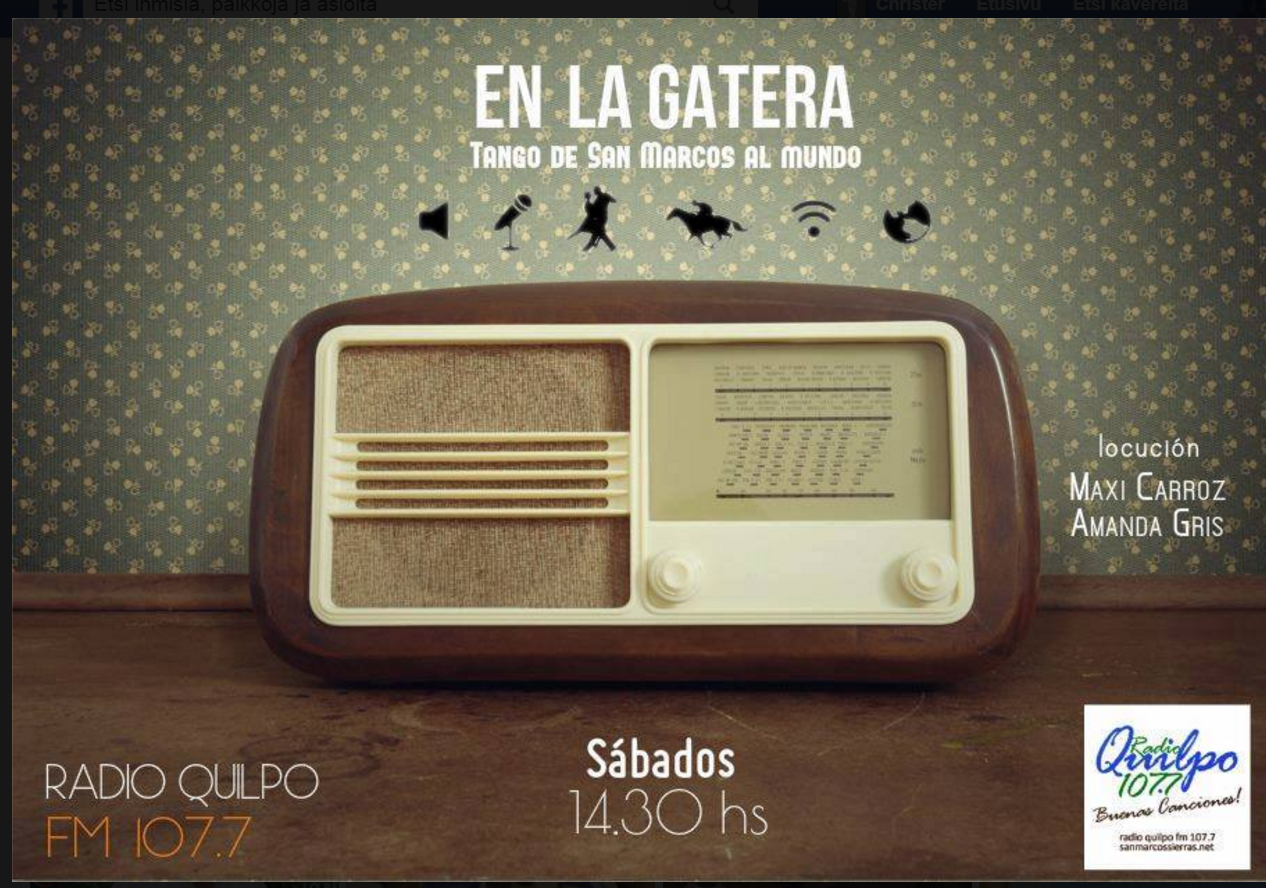
This year, Amanda and Maxi have started to produce a weekly radio program, named En la gatera, on the Radio Guilpo in San Marcos Sierras. In the program they talk about tango and its history, and play music. This project, indeed,  is a perfect example of the broad talent of the couple.


THE FUTURE OF TANGO
When I ask Amanda and Maxi of their thoughts on the future, they broaden my question to focus on the future of tango, itself. "We are coming back to the roots, and the so called Tango Nuevo seems to be disappearing", says Maxi. They welcome the growing number of tango musicians, and also point out the expanding number of tango teachers, both in Argentina and abroad.

Let me add − as a closing statement −  that more important than the number of tango teachers, is the number of excellent teachers − such as Amanda Gris and Maximiliano Carroz!